
WELCOME BONUS 300%
UP TO €2000 + 100
FREE SPINS
UP TO €2000 + 100
FREE SPINS
Home → Blackjack
Blackjack at Sugarino Casino: Variants, Rules and Payouts
Split Aces: Only One Card per Hand
When a player splits aces in Blackjack Split / double / H17, each ace usually receives one card only, and the rule effect of resplitting aces improves the return by 0.08 percentage points. That gain is small next to the 0.14 percentage points that doubling after a split adds, and the H17 rule removes 0.22 percentage points. A hand of two aces is therefore not played like a normal split pair.
Splitting produces up to four hands, and doubling after a split allows a further stake on the resulting two-card hand. The typical split stake is doubled with one card, so a €10 split on two aces keeps €10 on each of two hands rather than combining them into one larger bet. The one-card limit caps how much those hands can grow.
Compared with the 99.54% return of Blackjack 6 decks, S17, DAS, DOA, 3:2 payout with basic strategy, the ace split rule sits inside a rule set whose house edge is 0.46%. Because each ace gets one card, the player cannot hit again after the split, so the decision point ends there. Resplitting aces is the exception that improves the figure by 0.08 percentage points.
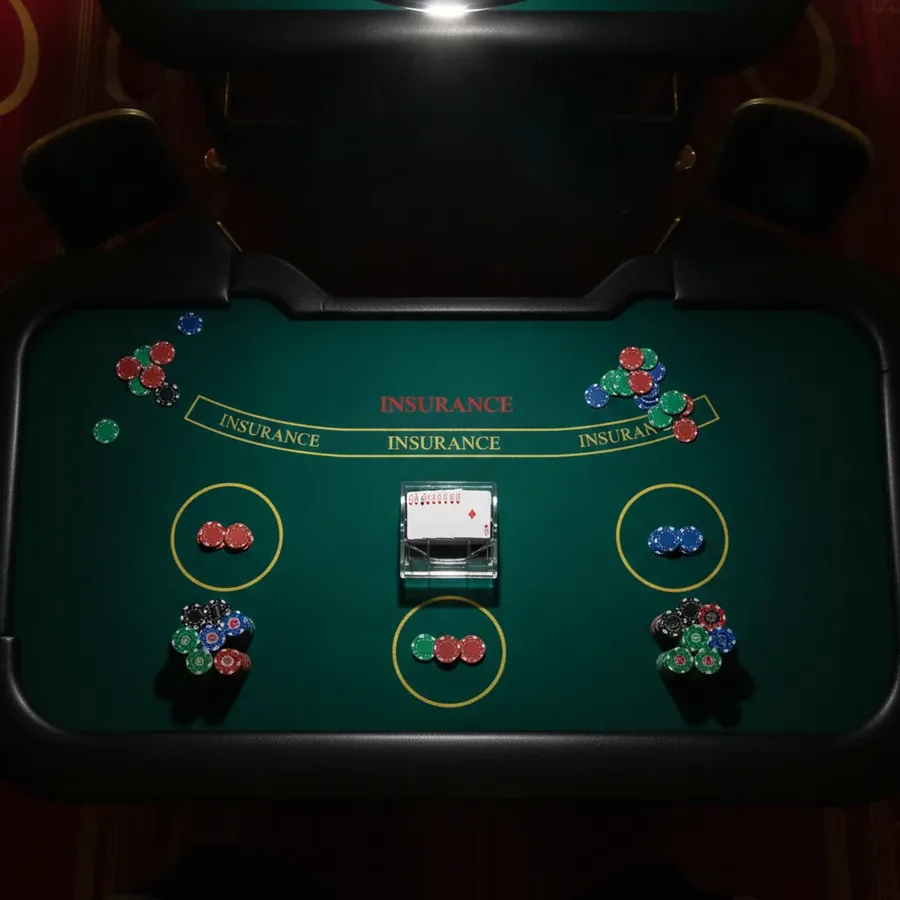
Side Bets Raise the House Edge to 5%
Insurance on 6–8 decks carries an RTP of 92.53% and a house edge of 7.47%, which is the share of each stake the casino keeps on average. Basic strategy always declines this side bet, since the return is far below the main game. On a €10 insurance stake the average cost works out to about €0.75 per round.
With a single deck the insurance edge is about 5.88%, so the same side bet is less costly on one deck than on six or eight decks. That difference of roughly 1.59 percentage points comes from deck composition. Even at the lower figure, the bet still gives back less than the main hand.
Only card counters at a true count of +3 or higher have a reason to take insurance, because the remaining deck then favors the bet. For everyone else the outcome is a side bet that pays 2:1 while lowering the long-run return. The main Blackjack 3:2 hand pays 1:1 on a regular win.
16 vs 10 played incorrectly: most common error
A hard 16 against a dealer 10 is the situation where basic strategy is broken most often, and the reference figure is the 99.54% return of Blackjack 6 decks, S17, DAS, DOA, 3:2 payout with basic strategy. That return assumes the player follows the correct action every time. Deviating on this one hand lowers the expected result over hundreds of thousands of rounds.
The rule set behind that 99.54% includes a dealer who stands on soft 17, double down on any first two cards, doubling after a split and no surrender. If the dealer instead hits soft 17, the return drops by 0.22 percentage points. A player who hits 16 against 10 on instinct alone moves away from the basic-strategy figure.
Late surrender is the modifier that gives the player an exit: giving up the hand after the dealer has checked for blackjack returns half the stake and improves the return by about 0.08 percentage points. Early surrender is worth up to 0.6 percentage points but is extremely rare. On a €10 bet, surrender returns €5 instead of risking the full amount.
Double Down or Just Hit on 11
Doubling down places a second stake equal to the first and takes exactly one more card, so a €10 bet becomes a €20 commitment on that hand. The rule effect of doubling after a split is about 0.14 percentage points of return, and doubling on any first two cards is part of the 99.54% figure for Blackjack 6 decks, S17, DAS, DOA, 3:2 payout with basic strategy.
Hitting on 11 keeps the original stake and allows further cards, so the maximum loss stays at €10 rather than €20. The trade is between a larger payout on one card and the flexibility of several draws. Blackjack 6 decks, S17, DAS, DOA, 3:2 payout, basic strategy reaches 99.54% only when the correct action is chosen for each hand.
Doubling after a split improves the return by roughly 0.14 percentage points, while resplitting aces adds 0.08 percentage points and a six-deck game gives up about 0.02 percentage points against eight decks. On a €10 double the win pays 1:1 on the doubled total, so the profit is €20 instead of €10. The exception is a dealer showing an ace, where insurance pays 2:1 but lowers the return in the long run.
Blackjack variants at a glance
| Variant | Payout | House edge | Rule | RTP |
|---|---|---|---|---|
| Blackjack Single deck, classic rules, 3:2 | Blackjack 3:2, win 1:1 | 0.15% | Fewer decks = lower edge; one deck gives about −0.48 percentage points compared with 8 decks. Often offset by a 6:5 payout. | 99.85% |
| Blackjack Insurance (6–8 decks) | Insurance 2:1 | 7.47% | Separate side bet of up to 50% of the main bet when the dealer shows an ace. Basic strategy ALWAYS declines it (except for card counters at a true count ≥ +3). With a single deck the edge is ≈ 5.88% | 92.53% |
| Blackjack 6:5 payout instead of 3:2 (6 decks) | Blackjack 6:5, win 1:1 | 1.85% | Replacing 3:2 with 6:5 adds exactly +1.39 percentage points to the casino's edge – more than any other rule change. On a €10 bet a blackjack pays €12 instead of €15. | 98.15% |
| Blackjack Liberal Vegas Strip (liberal rules, 3:2) | Blackjack 3:2, win 1:1 | 0.28% | The most player-friendly rule set: S17 + DAS + resplit + late surrender. Standard deviation 1.15 | 99.72% |
| Blackjack 6 decks, S17, DAS, DOA, 3:2 payout, basic strategy | Blackjack 3:2, regular win 1:1, insurance 2:1 | 0.46% | Dealer stands on soft 17; double down on any first two cards; doubling after a split allowed; no surrender. Basic strategy is required to reach this figure | 99.54% |
| Blackjack Surrender (late surrender) – rule effect | 50% of the stake returned | −0.08 percentage points | The player gives up the hand after the dealer has checked for blackjack and loses half the stake. Improves RTP by about 0.08 percentage points. Early surrender is worth much more (up to −0.6 percentage points) but is extremely rare. | n/a (rule modifier) |
Which Rule Variants the Software Shows
Blackjack Split, Double and H17 form the core rule set visible in the software, with dealer hitting soft 17 adding 0.22 percentage points to the house edge. Resplitting aces improves the return by 0.08 percentage points, while doubling after a split improves it by about 0.14 percentage points. Moving from 8 decks to 6 decks adds roughly 0.02 percentage points in the player's favour.
A 6:5 payout instead of 3:2 on a six-deck game produces a house edge of 1.85%, which is 1.39 percentage points worse than the standard 3:2 game. On a €10 bet a blackjack pays €12 instead of €15. That single rule change costs more than any other variation shown in the software and instantly signals a less favourable table.
Insurance appears as a separate side bet of up to 50% of the main bet when the dealer shows an ace, paying 2:1. The house edge on this bet is 7.47%, and basic strategy always declines it except for card counters at a true count of +3 or higher. A single deck would lower the edge to about 5.88%, but the software typically uses 6 to 8 decks.
Splitting Eights vs Standing on 16
Splitting eights creates up to four hands, while standing on 16 keeps one weak total against a dealer's strong upcard. The software allows doubling after a split, which improves the return by about 0.14 percentage points and makes the split decision stronger. Resplitting aces adds another 0.08 percentage points of value, though split aces usually receive only one card each.
A hard 16 against a dealer ten is a losing hand either way, but splitting eights turns one bad hand into two chances to build a stronger total. The liberal rule set with S17, DAS and late surrender reaches 99.72% RTP, while the six-deck S17 game with DAS and DOA but no surrender sits at 99.54%. The difference of 0.18 percentage points comes from the surrender option.
The cost of standing on 16 instead of splitting eights is not shown as a fixed house edge figure, but the rule modifiers are clear. H17 adds 0.22 percentage points to the house edge, while DAS subtracts 0.14 percentage points and RSA subtracts 0.08 percentage points. Playing at an H17 table without these options makes standing on 16 even more expensive in the long run.
Soft vs Hard Hands in Practice
A soft hand contains an ace counted as 11, such as ace-six for soft 17, while a hard hand has no ace or an ace forced to count as 1. The software's rule set shows dealer hitting soft 17, which raises the house edge by 0.22 percentage points compared with standing. That single rule directly affects how often the dealer improves a soft hand into a stronger total.
Doubling on any first two cards appears in the six-deck S17 game with DAS and DOA, which has a house edge of 0.46% under basic strategy. A player holding a soft 17 or soft 18 can double more aggressively when the dealer stands on soft 17, because the dealer's final hand is weaker. The same hand becomes harder to double profitably at an H17 table.
Late surrender offers a practical escape for hard hands, returning 50% of the stake after the dealer checks for blackjack. That option improves the return by about 0.08 percentage points and appears in the liberal Las Vegas Strip rule set at 99.72% RTP. Without surrender, a hard 16 against a dealer ten simply loses its full stake more often than any soft hand.
How many decks are in the shoe?
The software shows 6 to 8 decks in the shoe for most blackjack variants, with deck count changes worth about 0.02 percentage points between 8 and 6 decks. A single deck under classic rules reaches 99.85% RTP, which is 0.15% house edge and roughly 0.48 percentage points better than an 8-deck game. Fewer decks always lower the edge when the payout stays at 3:2.
The best multi-deck option is the liberal Las Vegas Strip rule set with 3:2 payouts, reaching 99.72% RTP and a 0.28% house edge. The six-deck S17 game with DAS and DOA follows at 99.54% RTP and 0.46% house edge. A six-deck game with a 6:5 payout collapses to 98.15% RTP and a 1.85% house edge, worse than any 8-deck 3:2 table.
Card counters benefit from fewer decks because the true count moves faster, but the software's 6 to 8 deck shoes reduce that advantage. Insurance only becomes profitable at a true count of +3 or higher, which is rarer with more decks. The single deck classic game at 99.85% RTP often gets offset by a 6:5 payout, making the 8-deck 3:2 game the better practical choice.
Doubling After a Split: Which Tables Allow It
Doubling after a split appears in the liberal Las Vegas Strip rule set, which reaches 99.72% RTP with S17, DAS, resplit and late surrender. The six-deck S17 game with DAS and DOA also allows the option, producing a 99.54% RTP and 0.46% house edge. The rule itself improves the return by about 0.14 percentage points compared with tables that forbid it.
Split aces usually receive only one card each, even at tables that allow doubling after a split. Resplitting aces adds 0.08 percentage points of value, and the software shows up to four hands after splitting. A player who splits eights and then doubles on one of the new hands needs the DAS rule active, otherwise the extra stake is not permitted.
The live tables from Evolution and Playtech do not explicitly list DAS in their rule summaries. Lightning Blackjack from Evolution shows a 99.56% RTP and Quantum Blackjack Plus Live from Playtech shows 99.57% with optimal strategy. Both figures sit close to the 99.54% six-deck S17 game with DAS, suggesting the rule is present but not guaranteed on every table.
Ignoring the Basic Strategy Chart: 1 Percent Wasted
Blackjack 6 decks, S17, DAS, DOA, 3:2 payout, basic strategy reaches an RTP of 99.54% and a house edge of 0.46%, where the house edge is the average share of each stake that the casino keeps over the long run. That 0.46% is only achievable when the player follows basic strategy on every decision, since the figure assumes correct play throughout. A player who ignores the chart and plays by feel gives back far more than 0.46% per hand, and over 100 rounds at €10 per round the difference quickly becomes real money lost.
Compare that with Blackjack Liberal Vegas Strip, whose liberal rules, 3:2 payout and S17 plus DAS plus resplit plus late surrender produce an RTP of 99.72% and a house edge of 0.28%. The gap between 0.46% and 0.28% is 0.18 percentage points, and that gap exists purely because of rule differences, not because of player skill. On €10 stakes across 1,000 hands, 0.18 percentage points equals roughly €18 of extra expected cost for the weaker rule set.
A blackjack pays 3:2, so a €10 bet returns €15, and a regular win pays 1:1 while insurance pays 2:1. Replacing 3:2 with 6:5 instead would drop the RTP to 98.15% and raise the house edge to 1.85%, which adds exactly 1.39 percentage points to the casino's edge, more than any other single rule change. On the same €10 bet, that blackjack would pay €12 instead of €15.
Stop the Session After a 30 Percent Loss
A session stop at a 30 percent loss is a self-set threshold rather than a casino rule, and it works like a fixed limit on a bankroll of €100, where the stop triggers at €30 lost. The house edge on Blackjack 6 decks, S17, DAS, DOA with basic strategy is 0.46%, so 100 rounds at €10 per round cost about €4.60 on average, well below the €30 threshold. That difference means the stop level matters far more for variance than for the theoretical edge.
Insurance is a separate side bet of up to 50% of the main bet when the dealer shows an ace, and it carries an RTP of 92.53% against a house edge of 7.47%. Basic strategy always declines insurance, so a player who takes it repeatedly at €5 per hand on a €10 main bet adds a 7.47% drag on that side stake. Over 100 insurance decisions at €5 each, the expected loss is around €37, which alone would breach a €30 stop on a €100 bankroll.
Late surrender lets the player give up the hand after the dealer has checked for blackjack and lose half the stake, improving RTP by about 0.08 percentage points. On a €100 bankroll with a €30 stop, surrendering a €10 hand returns €5 and caps that hand's loss at €5 instead of the full €10. Early surrender is worth up to 0.6 percentage points but is extremely rare, so late surrender is the version that matters in practice.
Continuous Shuffling Machines Reshuffle After Every Round
A continuous shuffling machine returns cards to the shoe after every round, which removes the deck-depth phase that card counters rely on. On Blackjack 6 decks, S17, DAS, DOA with a 3:2 payout, the RTP of 99.54% and house edge of 0.46% assume basic strategy rather than counting. With a continuous shuffling machine the count never drifts far from neutral, so the true count of +3 that justifies insurance for counters almost never appears.
Insurance carries an RTP of 92.53% and a house edge of 7.47% on 6 to 8 decks, and basic strategy always declines it. A counter who waits for a true count of at least +3 would find few opportunities under continuous shuffling, since the shoe resets constantly. A player who takes insurance anyway at €5 on a €10 main bet accepts a 7.47% edge against that €5, which is far worse than the 0.46% on the main hand.
Deck count itself shifts the edge: one deck gives about 0.48 percentage points less house edge than eight decks, and 6 decks instead of 8 decks is worth about 0.02 percentage points. A continuous shuffling machine neutralises the deck-depth advantage that a single-deck game would otherwise offer. The trade-off is a steady 0.46% edge on the main hand rather than a fluctuating one, which suits a flat-betting player more than a counter.
RNG Deals From a Virtual Eight-Deck Shoe
An RNG blackjack table draws cards from a virtual eight-deck shoe, and 6 decks instead of 8 decks is worth about 0.02 percentage points of house edge. Blackjack 6 decks, S17, DAS, DOA with a 3:2 payout shows an RTP of 99.54% and a house edge of 0.46% under basic strategy. A virtual eight-deck shoe therefore sits slightly worse than the six-deck figure, though the difference remains small at roughly 0.02 percentage points.
Splitting and doubling modify the edge in measurable steps: doubling after a split improves RTP by about 0.14 percentage points, resplitting aces by 0.08 percentage points, while the dealer hitting soft 17 lowers RTP by 0.22 percentage points. S17 keeps the dealer standing on soft 17, which avoids that 0.22 percentage point penalty. A player who doubles down on any first two cards and splits up to 4 hands with DAS captures the 0.14 percentage point gain that the weaker rule set would forfeit.
Insurance on 6 to 8 decks returns an RTP of 92.53% and a house edge of 7.47%, so on a €10 main bet the permitted side stake of up to €5 carries a 7.47% edge against it. Basic strategy always declines insurance, since the 2:1 payout does not offset the long-run cost. Over 100 such decisions at €5 each, the expected loss is roughly €37, which is far larger than the €4.60 average cost of 100 main hands at €10 under the 0.46% edge.
Clicked Too Late? The Hand Stands Automatically
A hand is held automatically when the decision timer expires, and on Blackjack 6 decks, S17, DAS, DOA with a 3:2 payout the RTP of 99.54% assumes basic strategy on every decision. A held hand is played by the default rule rather than by the player, so the 0.46% house edge no longer applies to that hand. One misplayed hand does not ruin a session, but repeated holds push the realised return below the theoretical figure.
Compare that with Blackjack Liberal Vegas Strip, where the liberal rules, 3:2 payout and S17 plus DAS plus resplit plus late surrender give an RTP of 99.72% and a house edge of 0.28%. The 0.18 percentage point gap between 0.46% and 0.28% is already lost through rule choice alone, before any timer lapse. On €10 stakes across 500 hands, 0.18 percentage points equals about €9 of extra expected cost, roughly the same as nine held hands played at a worse decision.
Late surrender returns 50% of the stake and improves RTP by about 0.08 percentage points, but only when the player acts in time. If the timer expires, the surrender option is gone and the hand is held instead, forfeiting that 0.08 percentage point gain. On a €10 hand, surrender returns €5, while a held hand played to a loss returns nothing, so the missed decision costs the full €5 difference.
Contact
Live - online chat
Banking









Providers












Sugarino Casino 2026